 Mishuk
Title Verification and Legal Due Diligence Before Buying Land or Apartments in Bangladesh
Buying land, an apartment, or a commercial space in Bangladesh is one of the biggest financial decisions a person ever makes. Yet most purchasers are still unaware of land documents vetting in Bangladesh. Before Buying Land or Apartments, complete the deal on the strength of trust, a few photocopies, and commitments from the broker and seller. From our years of practice as a property lawyer in Dhaka, we can tell you plainly: behind a beautiful plot or a ready flat there often hides a forged deed, a hidden mortgage, an undivided inheritance share, or a quiet court case waiting to surface after you have paid.
This is exactly why property legal vetting – the careful legal verification of every ownership document before you pay – is not a formality but the single most important step in any safe property transaction. This pillar guide explains what legal vetting is, how we conduct it, the documents we examine, the time and cost involved, and how a proper due diligence before buying land can save you from losing your hard-earned money. If you are an investor, an NRB, or a first-time buyer, read it once and you will understand the whole picture.
Why land documents vetting in Bangladesh mandatory in a Land or Apartment Purchase
Ownership of land in Bangladesh is not proved by possession alone. It is proved by an unbroken chain of registered documents, records of right, mutation, and tax payment. A seller may physically hold a property and still have no legal right to sell it. Legal vetting is the process by which a property lawyer reads that entire chain backward, tests it against government records, and confirms that the seller can lawfully transfer a clean title to you.
Skipping legal vetting exposes a buyer to risks that are common in Dhaka and across Bangladesh:
- Forged or tampered deeds, khatiyans, and National ID cards used to impersonate the real owner.
- Multiple sale of the same land or flat to several buyers – where the law protects only the first registered buyer.
- Hidden bank mortgages, charges, or liens that travel with the property after purchase.
- Undivided inheritance shares where one heir sells without the consent of the others.
- Properties under government acquisition, khas listing, waqf, or enemy/abandoned-property restrictions.
- Apartments built on disputed land or without valid RAJUK / MoHPW / NHA approval.
Any one of these defects can turn your investment into years of litigation. Land documents vetting in Bangladesh is mandatory because it converts a transaction based on trust into a transaction based on verified legal certainty.
How We Conduct Legal Vetting
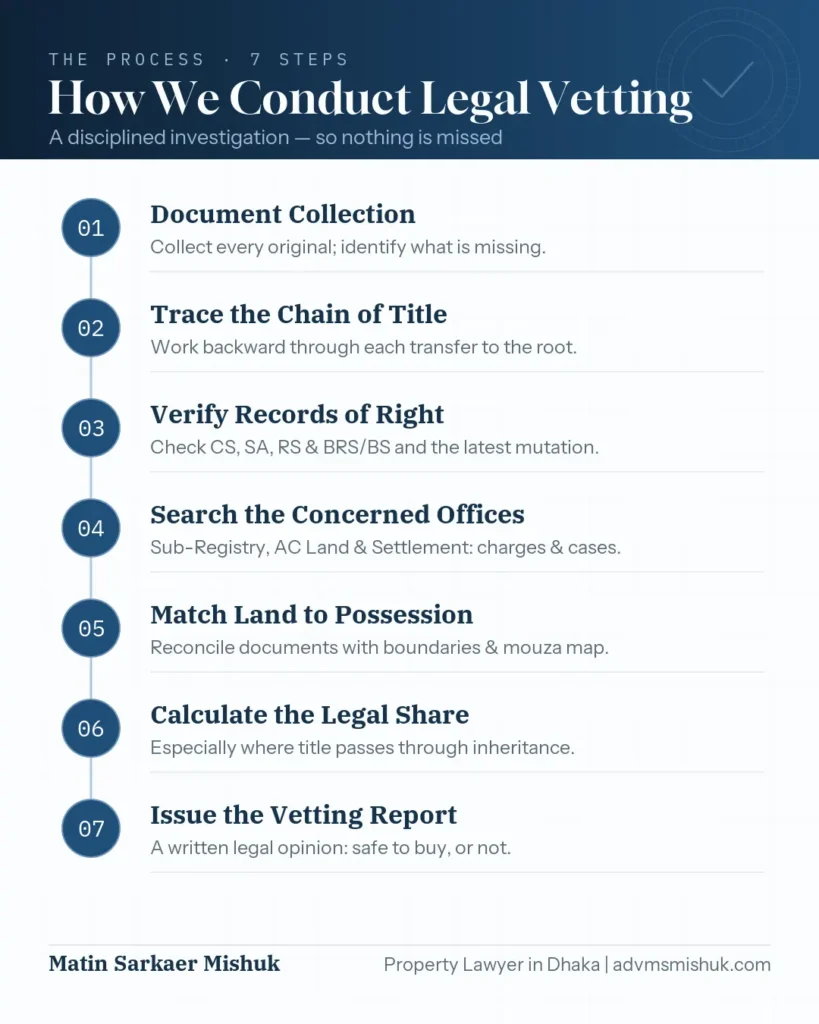
At our chamber, legal vetting is a structured investigation, not a quick reading of papers. When a client engages us, we follow a disciplined sequence so that nothing is missed:
- We collect every original document from the seller and identify which documents are missing.
- We trace the chain of title backward through each transfer to the root of title.
- We verify the records of right (CS, SA, RS, BRS/BS) and the latest mutation against government databases.
- We physically search the Sub-Registry, AC Land, Settlement, and concerned offices for encumbrances, cases, and competing transfers.
- We match the documented land with the physical possession, boundaries, and mouza map.
- We calculate the seller’s legal share, especially where the title comes through inheritance.
- Finally, we issue a written legal opinion (written Report on Letterhead describing our findings on Land Documents Vetting in Bangladesh) stating whether the property is safe to buy.
This is the same discipline we describe in our guide on how to buy land in Bangladesh, and it is the foundation of every safe registration and RAJUK property transfer we handle.
Legal Vetting Follows a Separate Procedure for Separate Entities
No two properties are vetted in exactly the same way. The seller’s legal character changes the documents we demand and the offices we search. Below is how the procedure shifts for each type of seller and property.
Individual Land or Apartment Seller
Where a single owner sells, we confirm the root of title, the via (previous) deeds, the latest khatiyan and mutation, and that the seller’s name matches every record exactly. We also confirm the seller’s identity, capacity, and that the property is free of any case, loan, or acquisition.
Joint Seller of Ejmaly (Undivided) Properties
In ejmaly or co-owned property, ownership is held in undivided shares. Here we calculate each co-sharer’s exact fraction, confirm that all heirs or co-owners consent to the sale, and check whether any partition (batwara) suit exists. Selling an undivided share without the others’ consent is a frequent source of dispute, so a succession certificate or warish record is often essential.
Legal Vetting for an Apartment
For a flat, the land beneath it matters as much as the unit. We verify the landowner’s title, the developer’s joint-venture deed and power of attorney, the deed of distribution, the approved building plan, and the developer’s authority to hand over your specific unit.
Legal Vetting for Land
For private land, the focus is the record chain – CS, SA, RS, and BS/BRS khatiyans – alongside mutation, khajna, and a careful possession check on the ground against the mouza map.
Land Documents Vetting in Bangladesh for Leasehold Property (RAJUK, MoHPW, NHA)
Leasehold property is owned by the government authority and only leased to the allottee. We examine the allotment letter, possession letter, lease deed, transfer/mutation permission, and any dues. Selling such property also requires RAJUK sale permission and a proper RAJUK mutation in the buyer’s name.
Land Documents Vetting for Joint Venture (JV) Developments
In JV projects we read the development agreement, the registered power of attorney from the landowner, the sharing arrangement, and the developer’s corporate documents to confirm that the unit being sold falls within the developer’s allocated share.
Legal Vetting for Banks and Financial Institutions
Before a bank accepts property as security, the same vetting protects the lender. We confirm a clean, mortgageable title, search for prior charges, and certify the property’s suitability for creating an equitable or registered mortgage.
Legal Vetting for Acquisition by Companies
When a company buy & sell property, we additionally check the company’s Memorandum and Articles, board resolution, and the authority of the signatory, alongside the full title investigation of the land or building itself.
Process of Searching
The heart of legal vetting is the search. This is where documents are tested against independent records. Our search covers the following stages.
(A) Title Search and Calculation
We trace ownership from the present seller back to the root, deed by deed, and calculate exactly how much title the seller legally holds today.
(B) CS, SA, RS, BRS Record Search and Analysis
We examine each record of right in sequence and cross-check it through the government land records database. Gaps, name mismatches, or skipped records are red flags that we resolve before clearing a property.
(C) Verification of Mutation Records
Current mutation (namjari), DCR, and up-to-date khajna (land tax) confirm that the seller’s ownership is recognised by the land office today, not decades ago.
(D) Verification of Lease, Allotment, and Possession Letter
For leasehold property, we confirm the allotment, possession, and lease documents directly with RAJUK, MoHPW, or NHA, and verify that no condition of the lease has been breached.
(E) Building Design and RAJUK Approval Verification
For apartments and structures, we verify the approved building plan and occupancy with RAJUK (or the relevant authority) so that you are not buying an unauthorised or deviated construction.
(F) Developer Agreement, Deed, and POA Verification
We read the joint-venture agreement, deed of distribution, and the developer’s power of attorney to confirm the developer’s legal right to sell your specific unit.
(G) Verification of Khas, Abandoned, or Government-listed Properties
We search the relevant DC office, settlement office, and authority lists to ensure the property is not khas, abandoned, enemy property, waqf, or listed for acquisition.
(H) Calculation of Title as per Inheritance Rules
Where title flows through inheritance, we apply the correct succession rules (Muslim farayez or the applicable non-Muslim law) to calculate each heir’s share precisely. A succession certificate or warish record is often required to complete this step safely.
Document Checklist for Property Legal Vetting
The exact documents we require depend on the property type. The table below is the working checklist we use during Land Documents Vetting in Bangladesh.
| Property type | Documents required for vetting |
| Private land | Title (saf-kobla) deed, all via deeds up to the root, CS / SA / RS / BS khatiyans, current mutation (khatiyan, DCR, khajna), warish / succession (if inherited), mouza map. |
| Apartment / flat | Landowner’s title and khatiyan, JV development agreement, registered POA, deed of distribution, deed of agreement for sale, approved RAJUK building plan, mutation, and the seller’s allotment of the specific unit. |
| Leasehold (RAJUK / MoHPW / NHA) | Allotment letter, possession letter, lease deed/agreement, transfer & mutation permission, sale permission, up-to-date dues/service charge clearance, title deed (if acquired by purchase or gift), warishan sanad. |
| Joint venture (developer) | MoA, AoA, Incorporation Certificate, Trade Licence, JV deed of agreement, power of attorney, power acceptance letter from lessor, deed of distribution, building plan approval, construction permission. |
| Bank / FI mortgage | Complete title chain, latest mutation, non-encumbrance/search certificate, valuation, and confirmation of mortgageable, dispute-free title. |
| Company acquisition | All land documents above plus the buyer company’s MoA & AoA, board resolution authorising purchase, and authority of the signatory. |
How Legal Vetting Safeguards Your Investment
The value of vetting is easiest to see when you compare a transaction done with proper due diligence against one done on trust alone.
| Risk area | Without legal vetting | With proper legal vetting |
| Ownership | Relies on the seller’s word and photocopies. | Title confirmed through registered deeds and government records. |
| Hidden mortgage / loan | Bank charge surfaces after payment; buyer inherits the debt. | Non-encumbrance search detects the charge; redemption arranged before payment. |
| Multiple sale | May become the second buyer with no legal right. | Prior sales and agreements detected before any money moves. |
| Inheritance dispute | A hidden heir claims a share years later. | Share calculated and all heirs’ consent secured in advance. |
| Court case / injunction | Discovered only when you are sued. | Pending cases found in the search and the deal stopped or fixed. |
| Government acquisition / khas | Possession lost to the State. | Acquisition and khas status verified before purchase. |
| Final outcome | Money lost, years of litigation, stress. | Clean title, safe registration, peace of mind. |
When Legal Vetting May Be Avoided
We never advise skipping verification, but the depth of vetting can reasonably be reduced in a few limited situations:
- When you already hold a complete, recently vetted set of documents for the same property from a land documents vetting lawyer in Bangladesh and nothing has changed.
- When the property is freshly partitioned family land with clear records and you personally know the full history.
- For a very small, low-value transaction between close family members where all heirs are present and consenting.
Even then, a basic title and encumbrance search is wise. As we always remind clients, the cost of vetting is a tiny fraction of the cost of a single property dispute case.
Time Required for Legal Vetting of Property Documents
Timing depends on the property type, the completeness of documents, and how quickly the concerned offices respond. As an indicative guide for Land Documents Vetting in Bangladesh in 2026:
| Property type | Documents complete | Documents incomplete |
| Private land | 3-5 working days | 1-2 weeks |
| Apartment / flat | 3-5 working days | 1-2 weeks |
| Leasehold (RAJUK/MoHPW/NHA) | 7-12 working days | 1-3 weeks |
| Inherited / ejmaly property | 5-10 working days | 1-3 weeks |
Where records are missing or a court search is involved, the timeline extends because we must collect certified copies and search multiple offices.
Expense and Lawyer Fees for Legal Vetting
The total cost of vetting has three parts: actual office/search expense, government fees, and the lawyer’s professional fee. The figures below are indicative ranges for Dhaka in 2026 and vary with complexity, location, and the number of records to be searched.
| Item | Office / search expense | Govt. fee | Lawyer fee |
| Certified copy of deed | BDT 300-5,000 each | BDT 100-500 each | Not Applicable |
| Khatiyan / record search (CS-SA-RS-BS) | BDT 500-1,000 per record | BDT 20-100 | Not Applicable |
| Mutation / khajna verification | BDT 300-500 | As applicable | Not Applicable |
| Non-encumbrance / 12-year search | BDT 1500-3,000 | Official search fee | Not Applicable |
| Private land vetting (overall) | – | – | BDT 20,000-50,000 |
| Apartment / flat vetting (overall) | – | – | BDT 20,000-50,000 |
| Leasehold / JV / complex vetting and modification | – | – | BDT 40,000-1,00,000+ |
Note: These are indicative figures, not a fixed quotation. For an exact estimate based on your documents, please contact our property law firm or book an appointment.
Expertise Required for Legal Vetting
Property vetting is a specialised field. A criminal or tax lawyer, however senior, is the wrong choice for reading a chain of title and maintaining a title tree. Engaging the wrong specialist is, as we often say, a waste of both time and money. Effective vetting demands a lawyer who works daily with land and real estate and who commands:
- Land law, the Registration Act, the Transfer of Property Act, and the State Acquisition and Tenancy Act.
- The records of rights – CS, SA, RS, BS/BRS and reconcile them.
- Inheritance law, including Muslim farayez and non-Muslim succession, to calculate shares correctly.
- RAJUK, MoHPW, and NHA leasehold procedure, including POA, Foreign Power of Attorney, Sale permission and Mutation.
- Practical search skills across the District Register, Sub-Registry office, AC Land, Survey, settlement, and Court.
- Real Estate Lawyer or Lawyer having vast knowledge of corporate legal procedure of property law and real estate and dispute settlement laws.
This combination of legal knowledge and field experience is what separates a real property lawyer in Dhaka from a general practitioner, and it is exactly what protects your money.
Case Study: How Vetting Saved a Dhanmondi Purchase
We recently completed a land transfer in Dhanmondi that shows why vetting matters. The purchaser had already settled the deal with the seller and came to us only for documentation and registration support. We insisted that he proceed with full legal vetting first. The initial payment date was already fixed, so we were in a rush to produce the report before any money changed hands.
One day before the scheduled payment, our search revealed that the land had already been signed over to a developer, and a case was pending before the 3rd Joint District Judge, Dhaka, to cancel the IGPOA. Had the buyer paid, he would have stepped straight into that litigation. We immediately stopped the payment, took over the matter, and got all the IGPOA cancelled within just four months – after which we registered the bayna (sale agreement) on clean title. A seven day vetting saved the client from years of loss and harassment.
Why Choose Us for Property Legal Vetting
We dedicate ourselves to practicing in the property and real estate law. We handle Land Cases, Real Estate Law, Documentation, Vetting of title, RAJUK sale permission, mutation, Registration, and power of attorney under one roof, so your matter stays consistent from the first search to the final deed.
- Specialist property lawyer and associates, not general practitioners.
- A written vetting report you can rely on before you pay.
- End-to-end service: vetting, agreement, sale permission, registration, and mutation.
- Full support for NRBs, including foreign power of attorney through the embassy.
- Confidentiality, fixed scope and clear pricing.
If you are buying from abroad, also read our dedicated guides on buying land in Bangladesh as an NRB, power of attorney from the USA to Bangladesh, and dual citizenship in Bangladesh.
You can find embassy and consulate details worldwide for property related services from abroad.
Frequently Asked Questions
What is Land Documents Vetting in Bangladesh?
Property legal vetting is the careful legal verification of all ownership documents of a land or apartment before purchase. A property lawyer traces the chain of title, checks government records, and confirms that the seller can lawfully transfer a clean, dispute free title to the buyer.
Why should I conduct legal vetting before buying land or an apartment?
Because possession and photocopies do not prove ownership in Bangladesh. Vetting protects you from forged deeds, hidden mortgages, multiple sales, undivided inheritance claims, government acquisition, and pending court cases any of which can cause you to lose your money.
What documents are required for Land Documents Vetting in Bangladesh?
Typically the title deed and all via deeds, the CS, SA, RS and BS khatiyans, current mutation, khajna and DCR, succession or warish records for inherited property, and – for leasehold or apartments – the allotment, lease, JV agreement, power of attorney, and approved building plan.
How can I verify the ownership of a property in Bangladesh?
By matching the seller’s registered deeds with the latest record of right and mutation, then searching the Sub-Registry and land offices for encumbrances and cases. Khatiyan and khajna can be checked through the government online land databases, but a lawyer’s search is essential for hidden defects.
Is mutation (Namjari) sufficient proof of ownership?
No. Mutation shows that the land office recognises your possession for tax purposes, but it does not by itself prove title. Ownership is established by the registered deeds and the unbroken chain of title, which mutation only supports.
How can I determine whether a property is involved in any pending court case?
Through searches at the Sub-Registry, the concerned civil court record room, and local enquiry. A property lawyer checks for suits, injunctions, and partition cases that may affect title or possession before you pay.
What are the risks of purchasing a property without legal vetting?
Forged documents, hidden bank mortgages, multiple sale, inheritance claims, government acquisition or khas listing, and pending litigation. Any of these can result in loss of the property, financial loss, and long civil or criminal proceedings.
Is legal vetting necessary when purchasing an apartment from a real estate developer?
Yes – arguably more so. You must verify the landowner’s title, the joint-venture agreement, the developer’s registered power of attorney, the deed of distribution, and the approved RAJUK building plan to confirm the developer can lawfully hand over your specific unit.
How long does the property legal vetting process usually take?
For private land with complete documents, around 5-10 working days; for apartments, 7-12 working days; and for leasehold or inherited property, two to four weeks or more if records are missing or a court search is required.
Can a lawyer issue a legal opinion after completing property vetting?
Yes. On completing vetting, a property lawyer issues a written legal opinion (vetting report) stating whether the title is clear, identifying any defects.
How can I verify whether the seller has the legal authority to transfer the property?
By confirming that the seller’s name appears in the latest record of right and mutation, calculating the seller’s exact share where title comes through inheritance, and for developers or attorneys, verifying the joint-venture deed and registered power of attorney.
What is a chain of title, and why is it important in property transactions?
A chain of title is the unbroken sequence of registered transfers from the present seller back to the root owner. An intact chain proves lawful ownership; any gap, mismatch, or missing link signals a defect that must be resolved before purchase.
How do I check whether any mortgage, charge, or encumbrance exists on the property?
Through a non-encumbrance search at the Sub-Registry and enquiry with banks and financial institutions. If a mortgage exists, redemption and a No Objection Certificate must be obtained before completing the purchase.
Can legal vetting identify government acquisition or requisition risks affecting a property?
Yes. We search the DC office, settlement office, and AC Land office to confirm the property is not under acquisition, requisition, khas listing, waqf, or abandoned/enemy-property restrictions before you buy.
What should I verify before purchasing inherited or jointly owned property?
Confirm the death of the original owner, identify every heir, calculate each share under the applicable succession law, secure the consent of all co-sharers, and obtain a succession certificate or warish record where required.
How can I verify RAJUK approvals and other regulatory permissions for an apartment project?
By verifying the approved building plan and permissions directly with RAJUK (or MoHPW/NHA for their schemes), confirming the land use and that the construction matches the sanctioned plan without unauthorised deviation.
Protect Your Investment Before You Pay
Property legal vetting is the cheapest insurance you will ever buy on a property.
Before you sign a bayna or release a single payment, let a specialist property lawyer confirm that the title is clean. To discuss your documents, book an appointment or contact us, and explore our full range of property legal services.