

An apartment purchase legal check is the one expense you should never cut when buying a flat in Dhaka. A flat is not only bricks and tiles. Behind it sit the landowner’s title, a joint venture agreement, a power of attorney, a RAJUK approved plan and the developer’s own promises. If any one of those links is weak, your flat is weak.
I am Matin Sarkaer Mishuk, Advocate, Supreme Court of Bangladesh, and before I started my own chamber I served as Head of Legal at a Dhaka real estate company. I have seen apartment files from both sides of the table. This page sets out the checks I run before any client pays booking money, signs an allotment letter or registers a deed.
Here is the rule I give every buyer: check the land, check the developer, check the building and only then check the price.
Who this service is for
I run this check for first-time flat buyers in Dhaka, families upgrading to a larger home, investors buying units to rent, and NRB buyers who cannot visit the project often. I also review files for buyers of resale flats, where the seller is an individual rather than a developer. The checks differ slightly, but the goal is the same: a flat you can live in, rent out or sell later without a legal problem following you.
Why every flat buyer needs an apartment purchase legal check
Most apartment disputes I handle come from problems that existed before the buyer paid a single taka. The most common ones are:
- The landowner’s title was defective, so the developer never had a clean right to build or sell.
- The joint venture agreement was unregistered or had expired.
- The developer built extra floors beyond the RAJUK approved plan.
- The same flat was allotted to two buyers.
- The project was mortgaged to a bank without the buyer’s knowledge.
- The deed did not mention the buyer’s undivided share of land.
- Handover was delayed for years with no compensation clause.
A proper apartment legal verification finds these issues early, when you can still walk away or negotiate protection.
The 15-point apartment purchase legal check
This is the checklist I use on every apartment file. It covers the land, the developer, the building and your contract.
Part A: The land under the building
- Landowner’s title chain: deeds going back at least 25 to 30 years, with no gaps.
- Record of rights: CS, SA, RS and city survey khatians matching the deeds.
- Mutation and land tax: namjari and DCR in the landowner’s name, land development tax paid.
- Leasehold status: for RAJUK, NHA or government leasehold plots, the lease deed, allotment and any required permissions.
- Litigation search: no pending suit, injunction or Land Survey Tribunal case over the plot.
Part B: The developer and the JVA
- Registered development agreement: the joint venture agreement (JVA) between landowner and developer, with the share ratio and your flat in the developer’s portion.
- Registered irrevocable power of attorney: from landowner to developer, authorising sale of the developer’s share. Registration is compulsory under the Power of Attorney Act, 2012.
- Developer registration: under section 5 of the Real Estate Development and Management Act, 2010.
- Mortgage status: section 16 of the same Act bars selling mortgaged real estate without the buyer’s consent. I verify bank lien and clearance.
Part C: The building
- Approved plan: RAJUK or the relevant authority’s approval, matching the actual number of floors and units.
- Your unit on the plan: the flat number, floor and size must exist on the approved drawings.
- Occupancy certificate: for completed buildings, the certificate under the Dhaka Building Construction Rules, 2008.
- Utilities: applications or connections for electricity, water and gas, as promised under section 13 of the Act.
Part D: Your contract and deed
- Allotment letter and agreement: price, payment schedule, handover date, delay compensation, specifications and parking clearly written.
- Deed of sale: must convey the flat together with an undivided proportionate share of land and common areas.
Under-construction flat or ready flat: what changes
| Check | Under-construction flat | Ready flat |
|---|---|---|
| Main risk | Delay, non-completion, plan deviation | Title defects, deviation already built, hidden dues |
| Key document | Registered JVA and power of attorney | Occupancy certificate and handover papers |
| Payment | By instalment through bank, linked to progress | Usually lump sum at registration |
| Contract focus | Handover date and delay compensation | Clear title, no dues, possession on registration |
| Physical check | Site progress against the approved plan | Flat size, finishes, common areas, parking |
| After purchase | Monitor progress, demand handover | Mutation, holding tax, association membership |
Documents to collect before booking a flat
- Landowner’s title deeds and full chain of earlier deeds
- CS, SA, RS and city survey khatians and mouza map
- Mutation khatian, DCR and land development tax receipts
- Registered joint venture or development agreement
- Registered irrevocable power of attorney from landowner to developer
- RAJUK or relevant authority approved plan with approval letter
- Developer’s trade licence, TIN, and registration certificate
- Draft allotment letter and payment schedule
- Bank clearance or non-encumbrance letter, if the project was financed
- Occupancy certificate, for completed buildings
- For resale flats: the seller’s registered deed, mutation and holding tax receipts
What the Real Estate Development and Management Act, 2010 gives you
Many buyers do not know how much protection the law already gives them. Key provisions include:
- Section 8: a developer cannot sell an allotted flat to another buyer without your consent.
- Section 9: after full payment, the developer must hand over possession and register the deed within 3 months.
- Section 12: payments are to be made through the bank, as set out in the allotment letter.
- Section 14: an allotment cannot be cancelled for default without 60 days’ registered notice.
- Section 15: if the developer fails to deliver on time, you are entitled to a refund with compensation, and the Act sets a fallback rate where the contract is silent.
- Section 18: the developer must hand over the approved plans, structural design and possession documents.
- Section 36: disputes go first to negotiation and then to arbitration under the Arbitration Act, 2001.
If your project is already delayed, see my page on real estate arbitration and delayed handover.
Clauses I add to protect flat buyers
Developers usually hand buyers a printed allotment letter and say it is “standard”. It is not standard. It is drafted to protect the developer. When I review an apartment file, I negotiate clauses such as these:
- Fixed handover date: a real calendar date, not “within a reasonable time”.
- Delay compensation: a monthly amount or rate payable automatically after the handover date.
- Size tolerance: price adjustment if the measured flat is smaller than promised, as section 9(2) of the Act also requires.
- Specification schedule: brand and grade of tiles, fittings, lift and generator attached as an annexure.
- Parking: parking slot number written in the agreement and in the deed.
- Refund on cancellation: timeline and method of refund if the project fails.
- No mortgage without consent: a promise that the developer will not mortgage your unit.
- Common area rights: roof, lobby, community hall and generator room kept as common property.
A developer who refuses every reasonable clause is telling you how it will behave after you pay.
Warning signs in brochures and sales offices
- “Approval is in process” for a project already selling flats
- More floors in the brochure than on the approved plan
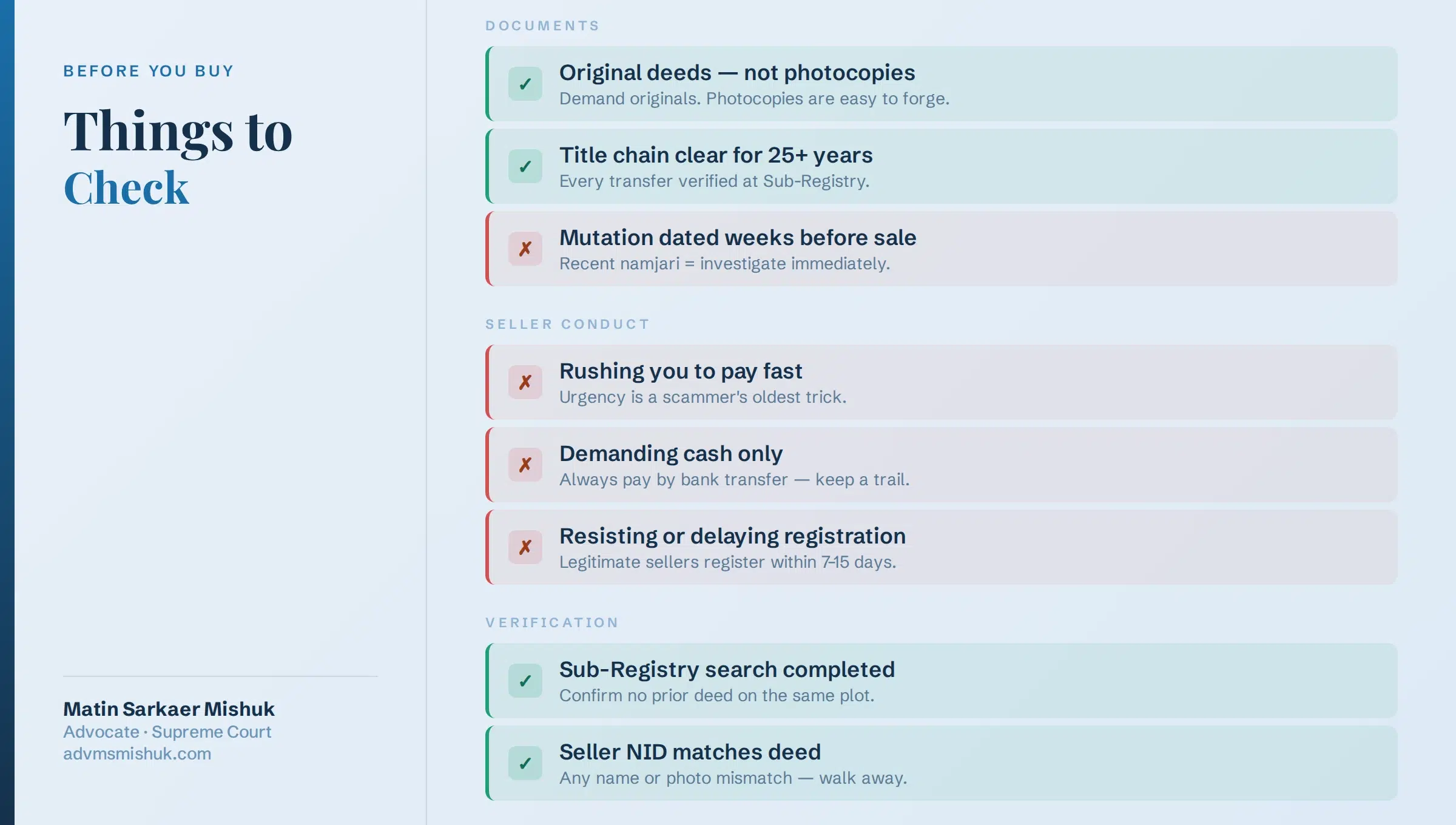
- Pressure to pay cash or into a personal account
- Refusal to show the JVA or power of attorney “for privacy reasons”
- Very low price compared with nearby projects
- No registered office or trade licence in the company’s name
Your first 90 days after buying a flat
The legal work does not end at registration. To complete your title and protect it, I guide clients through these steps:
- Collect the registered deed and certified copy from the Sub-Registry.
- Apply for mutation of your proportionate land share at the AC Land office.
- Register for holding tax with the city corporation.
- Transfer utility connections and meters into your name.
- Join or help form the apartment owners’ association.
- For leasehold land, complete mutation in the RAJUK or authority file.
- Keep originals in a safe place and scanned copies with your lawyer.
Registration costs and the final deed
At registration you will pay stamp duty, registration fee, local government tax and the applicable gain tax or VAT. The rates are set by the current Finance Act and differ by area, so I calculate the exact amount for your flat before the registration date. I also check that the deed value, the flat size and the land share in the deed match your agreement. After registration, mutation of your proportionate land share and holding tax registration with the city corporation complete your title.
Flats on RAJUK and other leasehold plots
In Gulshan, Banani, Baridhara, Uttara, Purbachal and other leasehold areas, the land belongs to RAJUK or another authority under a long-term lease. Transfer of a flat on such land usually needs permission from the authority, followed by mutation in its records. Skipping this step leaves you with a registered deed but an incomplete title in the authority’s file. I handle this as a separate service: RAJUK sale permission and mutation. I have also written a detailed guide on the RAJUK property transfer process.
A typical scenario from practice
A common file on my desk: a family books a 1,450 sq ft flat on the 9th floor of a Bashundhara project, pays booking money and four instalments, then learns the RAJUK approval covers only 8 floors. The 9th floor exists only in the brochure.
In these situations, the buyer has three paths: negotiate a shift to an approved unit, claim refund with compensation under section 15, or enforce through arbitration. A 30 minute apartment purchase legal check at the start, comparing the brochure with the approved plan, would have shown the problem before any payment.
Apartment legal verification for NRB buyers
Many of my apartment clients buy from the USA, UK, Canada and the Gulf. I can run the full check remotely, attend site visits with photo and video reports, review the allotment letter line by line and coordinate registration through your attorney. For the attorney process, see power of attorney for NRBs.
How this service connects to land verification
The land check inside an apartment file follows the same method I use for plots and land. You can read the full method on my property verification and legal vetting page, and my article on land documents vetting in Bangladesh. If a dispute has already started with your developer, see developer-buyer disputes on and after JVA.
Frequently asked questions
What documents should a developer show before I book a flat?
At minimum: the landowner’s title deeds, a registered joint venture or development agreement, a registered power of attorney from the landowner, the approved building plan and the developer’s registration. If any of these are missing, do not book.
Is a JVA required to be registered?
A development agreement with an irrevocable power of attorney in favour of the developer must be registered. Registration protects both the landowner and buyers of the developer’s share.
What happens if the developer delays handover?
Under section 15 of the Real Estate Development and Management Act, 2010, you can claim a refund with compensation, at the contract rate or the statutory fallback rate. Disputes go to negotiation and then arbitration under section 36.
Do I get a share of the land when I buy a flat?
You should. The deed must convey the flat together with an undivided proportionate share of the land and common areas. Without it, your title is incomplete.
How long does an apartment purchase legal check take?
For a project with a complete file, usually 5 to 7 working days. Leasehold plots and long title chains can take longer.
Can I buy a flat in Dhaka from abroad?
Yes. Through a properly authenticated power of attorney, a trusted person can sign and register for you, while I handle the legal checks and coordinate the process.
Book your apartment purchase legal check
Send me the brochure, allotment letter and whatever documents the developer has shared. I will tell you what is missing, what is risky and what to negotiate before you pay.