

Owning property in Bangladesh while living abroad is a quiet risk. Nothing happens for years, and then one phone call changes everything: a boundary wall has moved, a tenant has stopped paying and claims the flat, a relative has “sold” the land, or the khatian now shows someone else’s name. NRB property management is not about collecting rent. It is about keeping your title, your possession and your records under your control from thousands of miles away.
I am Matin Sarkaer Mishuk, Advocate, Supreme Court of Bangladesh. NRB families in the USA, UK, Canada, Europe and the Gulf are at the centre of my practice. This page explains the risks NRB owners face, the safeguards I put in place and how I resolve disputes when they arise.
The principle I work by: prevention is a small yearly cost; a land dispute is a large cost for many years.
Why NRB property is a target
Property owned by people abroad is attractive to land grabbers and dishonest insiders for simple reasons:
- No one is physically present to object when someone enters the land.
- Tax and mutation records are left unattended for years.
- Caretakers and relatives gain control of documents and keys.
- Owners rely on verbal promises rather than written agreements.
- By the time the owner visits, limitation periods may have run.
None of this means you should sell. It means you need a system.
Risks, safeguards and remedies at a glance
| Risk | How I prevent it | What I do if it happens |
|---|---|---|
| Illegal occupation or encroachment | Boundary marking, signboard, periodic site visits | Section 9 suit within 6 months, injunction, land crime complaint |
| Fraudulent sale or forged deed | Records monitoring, Sub-Registry checks, secure originals | Suit for declaration and cancellation, criminal complaint |
| Misuse of power of attorney | Narrow, time-bound powers; payments to owner’s account | Revocation, notice to offices, legal action against the attorney |
| Tenant default or overstay | Written tenancy, rent through bank, inspection clause | Legal notice, rent recovery and eviction proceedings |
| Caretaker claims rights | Written caretaker licence, no tenancy created | Notice to vacate, possession suit |
| Record changed in another name | Annual e-Porcha and mutation check | Objection, mutation appeal, Land Survey Tribunal case |
| Tax arrears and certificate cases | Online land development tax and holding tax payment | Clear arrears, contest wrongful demands |
| Developer delay or deviation | Contract review, progress monitoring | Notice, arbitration, compensation claim |
Ten safeguards for NRB property management
- Records audit: I check the title chain, khatians and mutation for every property you own, and fix gaps while things are calm.
- Mutation in your name: if land is still recorded in a parent’s or seller’s name, complete mutation now. Inherited land needs a warish certificate and, ideally, a bontonnama; see my page on warish certificate for inherited property.
- Taxes paid and recorded: pay land development tax through the official land tax portal and holding tax with the city corporation. Tax receipts are evidence of possession.
- Online record checks: check your khatian at least once a year through e-Porcha, so you notice any change early.
- Physical marking: boundary pillars or a wall, and a signboard showing ownership and a contact number.
- Written tenancy: every tenant on a written agreement, rent through bank transfer, with clear terms on duration, increase and inspection, consistent with the Premises Rent Control Act, 1991.
- Caretaker licence: a caretaker should hold a written licence to stay, not a tenancy, and should never hold original documents.
- Safe originals: original deeds in a bank locker or with your lawyer, scanned copies with you.
- Controlled powers of attorney: specific, time-bound and with money paid to your account. See power of attorney for NRBs.
- Regular reports: a site visit with photos and a short written report at fixed intervals.
When a dispute starts: how I respond
Act inside the first weeks
Speed matters most in possession disputes. Under section 9 of the Specific Relief Act, 1877, an owner dispossessed without due process can recover possession through a summary suit filed within 6 months, without proving title in detail. After that window, you need a full title suit, which is slower.
Secure evidence
I collect photographs, certified copies of records, tax receipts and witness details immediately. Evidence fades quickly when you live abroad.
Legal notice
A firm legal notice often stops a weak claimant and opens a route to settlement. Notices are explained on my page on legal vetting, notice and opinion for specific remedies.
Court and criminal routes together
Where there is forgery, fraudulent sale or forcible occupation, the Land Crime Prevention and Remedy Act, 2023 provides criminal remedies alongside civil suits. Where peace is threatened, proceedings under section 145 of the Code of Criminal Procedure can freeze the position. The civil route is covered on my page on civil litigation for property title disputes.
Settlement where it makes sense
Family disputes over inherited land often end best in a registered settlement or bontonnama. I recommend settlement when it protects your share and your time, and a firm fight when there is fraud.
Documents to keep ready
- Copies of all title deeds and the earlier chain
- Latest khatian, mutation and DCR
- Land development tax and holding tax receipts
- Approved building plan and occupancy certificate, for buildings
- Tenancy agreements and rent records
- Caretaker agreement
- All powers of attorney you have given, with their status
- Photographs of the property with dates
- Your passport and NID copies
Why time works against owners abroad
Many NRB owners believe that because the deed is in their name, the land is safe forever. The law is less forgiving. Under the Limitation Act, 1908, a person who holds land openly and continuously against the owner for 12 years can, in some circumstances, defeat the owner’s suit for possession. A caretaker or tenant usually cannot claim this while the arrangement is acknowledged, which is exactly why written agreements and rent records matter. An informal arrangement with no paper trail is the easiest one for an occupier to turn into a claim of hostile possession.
Time also matters for records. If a wrong name appears in the final survey record and no one objects within the time allowed, correcting it later means a case before the Land Survey Tribunal. Every year you wait makes the evidence older and the case harder.
Tenancy problems I see most often
- No written agreement: the tenant later claims a long lease or a promise to sell.
- Cash rent: no record of payment, so arrears are hard to prove.
- Sub-letting: the tenant rents rooms to others without consent.
- Unpaid utilities: bills pile up in the owner’s name.
- Refusal to vacate: the tenant stays after the term ends.
Each of these can be prevented with a short written agreement and bank payments, and resolved with a legal notice followed by the appropriate proceeding if needed.
Your yearly property health check
For clients on my NRB property management service, I run a yearly check covering:
- Khatian and mutation status for each property
- Land development tax and holding tax paid for the year
- Any new deed, mortgage or power of attorney registered over the property
- Any suit, notice or certificate case involving the property
- Physical condition, boundaries and occupants
- Tenancy and caretaker agreements still valid
- Status of any power of attorney you have given
You receive a short written report with photos, so you know exactly where you stand before any problem grows.
Costs of NRB property management
I offer the service on a fixed yearly fee, scaled to the number and type of properties, plus actual government fees and travel for distant sites. Disputes that need court action are quoted separately, with a written estimate before work starts. For most clients, the yearly cost is a small fraction of the rent the property earns, and far less than one contested suit.
A typical scenario from practice
A common file: an engineer working in Dubai owns 4 katha of land in Rupganj, bought ten years ago. A local man was paid to look after it. Over time, he builds a tin shed, rents it to two families and starts telling neighbours the land is his. The owner learns of this only when a buyer shows interest.
My approach in such a case is to issue a legal notice to the caretaker and occupants, collect the owner’s tax receipts and records as proof of possession, and file for possession and injunction. Because the owner’s mutation and tax payments were up to date, the claim of ownership by the caretaker has no documentary base. The lesson for other owners is simple: keep the records current and keep caretaker arrangements in writing.
Family members as managers
Many NRB owners leave property with a brother, cousin or parent, and most of these arrangements work well. Problems start when roles are unclear. Who collects rent? Who pays tax? Who keeps the originals? Can the family member sign anything? I recommend writing these answers down in a short management letter or a specific power of attorney. It protects the family relationship as much as the property. When an inherited property is shared among siblings, a registered bontonnama first, and a management arrangement second, avoids the most common family disputes I see.
If a family dispute has already started, I try to settle it on paper before it reaches court. A registered settlement that fixes shares, possession and rent is often worth more than a decree that takes years.
Property management with developers
Many NRB owners hold land under a joint venture with a developer or have booked flats that are years late. These are management problems too. I review the JVA, monitor progress against the approved plan and handle disputes through notice and arbitration. See developer-buyer disputes on and after JVA and real estate arbitration and delayed handover.
Buying or selling while abroad
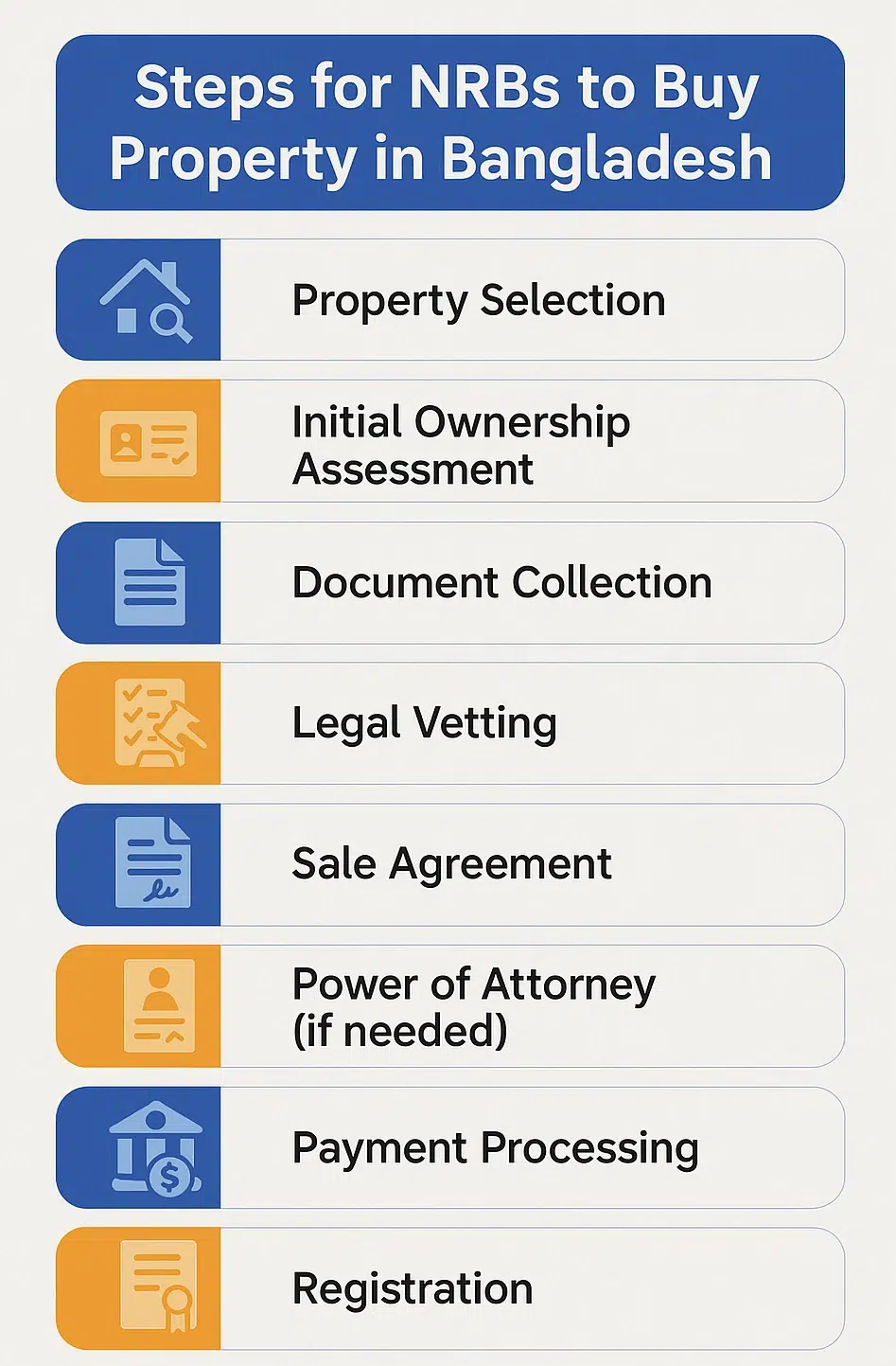
If you plan to buy, start with property verification and legal vetting or an apartment purchase legal check. My guide on how to buy land in Bangladesh as an NRB gives the full picture, and my article on multiple sale scams shows what to watch for.
What my NRB property service includes
- Initial audit of every property and its records
- Correction of mutation, tax and record gaps
- Drafting of tenancy, caretaker and management agreements
- Drafting and processing of powers of attorney
- Periodic site inspection with photo report
- Annual record check and tax status report
- Rapid response, legal notice and litigation when disputes arise
- Video meetings at times that suit your time zone
Frequently asked questions
What is the biggest risk for NRB property owners?
Loss of possession through illegal occupation or a caretaker claiming rights, followed by record changes. Both are easier to stop early than to reverse later.
How quickly must I act if someone occupies my land?
Within 6 months of dispossession you can use the summary remedy under section 9 of the Specific Relief Act, 1877. After that, you need a regular title suit.
Can I manage tenants from abroad?
Yes, through a written tenancy agreement, rent paid by bank transfer and a trusted local representative or lawyer for inspections and notices.
How can I check if my land record has changed?
Check your khatian online through e-Porcha at least once a year, and ask your lawyer to verify mutation and Sub-Registry records periodically.
Is it safe to give my relative a general power of attorney?
It can be, if it is specific, time-bound and requires money to be paid to your account. Broad, open-ended powers are the most common cause of loss for NRB owners.
Do you handle disputes outside Dhaka?
Yes. I handle NRB property matters in Dhaka, Narayanganj, Rupganj, Gazipur, Cox’s Bazar and other districts.
Protect your property in Bangladesh
Send me a list of your properties and the documents you have. I will run a records audit, show you where the risks are and set up a management plan that fits your situation abroad.