

Property verification is the step that decides whether you buy a property or buy a lawsuit. In Dhaka, a deed can look clean, a seller can look honest and a khatian can carry the right name, yet the land can still be under a pending suit, a bank mortgage or a second sale. I am Matin Sarkaer Mishuk, Advocate, Supreme Court of Bangladesh, and for more than 8 years I have verified land, plots and apartments for local buyers, NRB families and real estate companies.
This page explains how I carry out property verification and legal vetting, what documents I need, how long it takes and what you receive at the end.
If you are short on time, here is the core message: never pay bayna (advance) money before an independent lawyer has checked the title chain, the record of rights, the tax position and the physical possession. Everything else on this page explains why.
What property verification really means in Bangladesh
Many buyers think property verification means checking whether the seller’s name is on the deed. That is only the first page of the file. Proper legal vetting answers four questions:
- Ownership: Does the seller hold a valid, unbroken title?
- Records: Do the CS, SA, RS and city survey records support that title?
- Encumbrance: Is the property free from mortgage, lien, attachment or prior agreement?
- Possession: Is the seller in actual, peaceful possession on the ground?
If any one of these answers is “no” or “unclear”, the deal needs a fix before money changes hands. Sometimes the fix is simple, such as an updated mutation. Sometimes it is serious, such as a pending declaration suit. My job is to find it before you sign, not after.
Why buyers in Dhaka lose money without legal vetting
The risks are not theoretical. These are the patterns I see most often in my chamber:
- Multiple sale: the same land sold to two or three buyers through separate deeds or bayna agreements.
- Forged or “power” based sales: a person sells under a power of attorney that was cancelled, expired or never valid.
- Missing heirs: one or two heirs sell inherited land without the consent of brothers, sisters or the widow.
- Record mismatch: the deed says one dag number, the khatian says another, and the land on the ground is a third plot.
- Hidden mortgage: the property is pledged to a bank and the seller plans to clear the loan “after the sale”.
- Government or khas claim: the plot falls within acquired, vested or khas land.
I have written a detailed guide on one of these risks in multiple sale scams in land and apartments. The common thread is simple. Each of these problems was visible in the documents or at the land office before the buyer paid. Nobody looked.
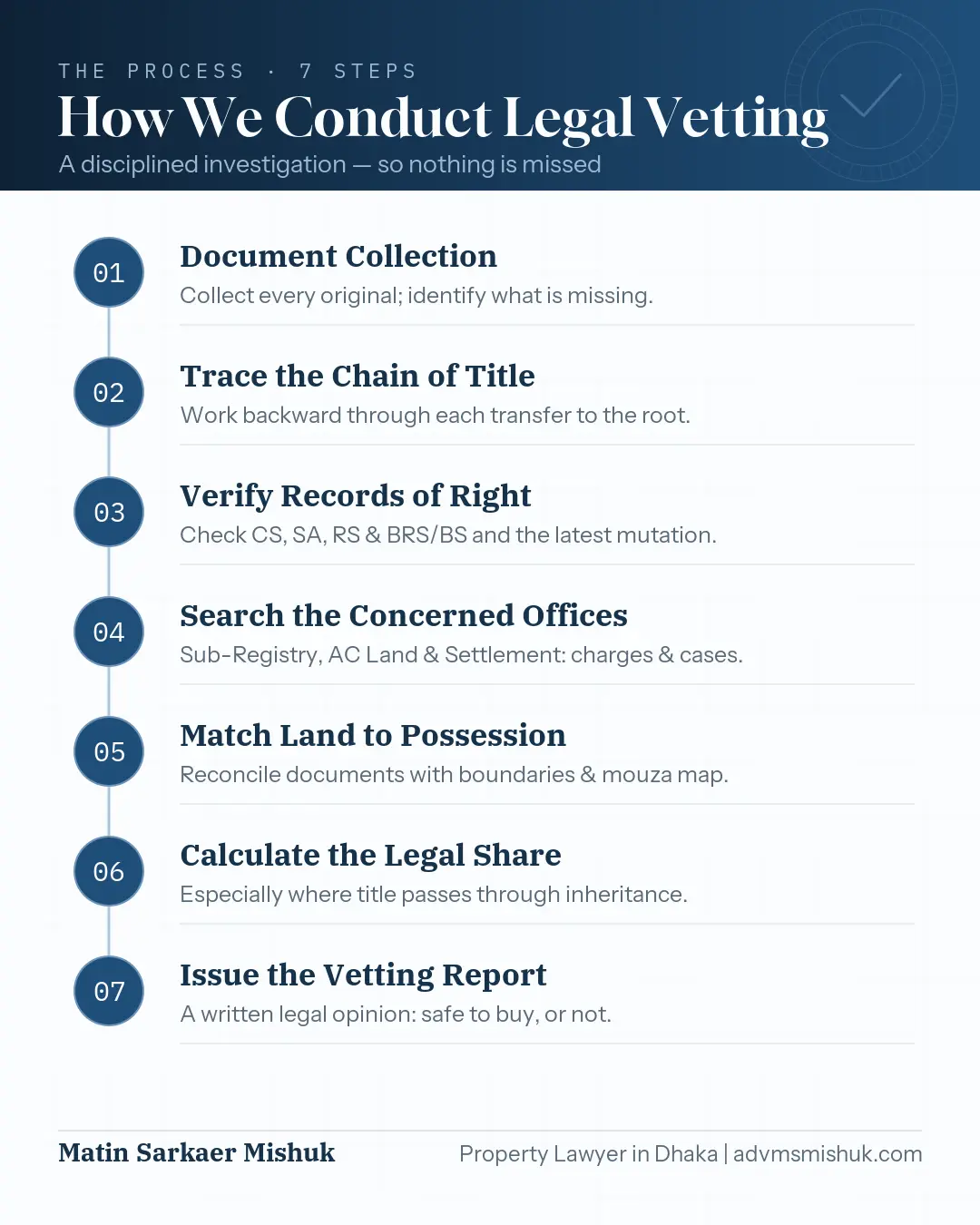
My property verification process, step by step
I follow the same structured process on every file, whether it is a 3 katha plot in Purbachal, an apartment in Bashundhara or ancestral land in Rupganj. Here is how it works.
Step 1: Document intake and first review
You send me copies of the seller’s documents. I read the full title chain, mark gaps and prepare a written list of missing papers. At this stage I can already tell you whether the file is worth pursuing.
Step 2: Title chain analysis
I trace ownership backwards from the current seller, deed by deed, usually covering at least 25 to 30 years and often back to the CS record. Every transfer must connect to the next. A gap in the chain, a deed by a person who never owned the land, or an inheritance that skipped an heir is a red flag.
Step 3: Record of rights check
I compare the CS, SA, RS and city survey (or BS) khatians with the deeds. Dag numbers, land quantity and owner names must match. Where the latest record is wrong, I assess whether it can be corrected through mutation or needs a case before the Land Survey Tribunal under section 145A of the State Acquisition and Tenancy Act, 1950.
Step 4: Mutation and tax verification
I verify the seller’s mutation (namjari) and DCR, and check that land development tax is paid up to date. Online records can be checked through the e-Porcha portal and the land development tax portal, but I never rely on screenshots alone. The physical register at the AC Land office is the final word.
Step 5: Sub-registry search
Through the Sub-Registry office I search for any later deed, bayna agreement, mortgage or power of attorney registered over the same land. This is where multiple sale problems usually surface.
Step 6: Litigation and encumbrance search
I check for pending civil suits, injunctions, Land Survey Tribunal cases and certificate cases against the land or the seller. For apartments and developer projects, I also check bank mortgages and the developer’s agreement with the landowner.
Step 7: Physical inspection and possession check
Papers do not show who is actually on the land. I or my team visit the site, verify boundaries with the mouza map, speak to neighbours where useful and confirm that the seller is in peaceful possession.
Step 8: Written legal opinion
You receive a clear written opinion: what is clean, what is risky, what must be fixed before signing and what clauses must go into the deed or agreement. No jargon. No vague “subject to” language.
Documents I need for property verification
Collect photocopies or clear scans of the following. If the seller refuses to share any of them, treat that as your first warning.
For land and plots
- Current sale deed or title deed of the seller (dolil)
- All previous deeds in the chain (bia dolil), at least 25 to 30 years back
- CS, SA, RS and city survey or BS khatian copies
- Mouza map showing the dag
- Mutation (namjari) khatian and DCR in the seller’s name
- Up to date land development tax receipts (dakhila)
- Warish (heirship) certificate and bontonnama, where the land came through inheritance
- Power of attorney, if anyone is selling on behalf of the owner
- Non-encumbrance certificate or bank clearance, if the land was ever mortgaged
- NID copies of all sellers
For apartments and flats
- Registered joint venture or development agreement between landowner and developer
- Registered irrevocable power of attorney from landowner to developer
- RAJUK or relevant authority approved building plan
- Land title documents of the landowner (as listed above)
- Allotment letter, payment receipts and draft deed of the flat
- Occupancy certificate, where the building is complete
- Developer’s registration under the Real Estate Development and Management Act, 2010
For apartments, I have a separate service with a full checklist: must-do apartment purchase legal check.
Red flags and what they usually mean
The table below summarises the warning signs I see most often during property verification and the action I normally recommend.
| Red flag found | What it usually means | My usual recommendation |
|---|---|---|
| Seller’s name not in latest khatian | Mutation not done or title is disputed | Complete mutation before deed; hold payment |
| Gap in the title chain | Missing deed or unrecorded inheritance | Trace and collect missing deed or heirship papers |
| Land quantity differs between deed and khatian | Over-selling or record error | Buy only the verified quantity; correct records |
| Sale through power of attorney | Risk of cancelled or invalid power | Verify registration, scope and validity at Sub-Registry |
| Prior bayna agreement found | Another buyer may claim specific performance | Obtain registered cancellation or walk away |
| Pending civil suit or injunction | Title is under challenge | Do not buy until the suit is resolved |
| Unpaid land development tax for years | Weak possession or neglected title | Clear arrears at seller’s cost before signing |
| Third party in possession | Adverse claim or tenant dispute | Resolve possession in writing before payment |
The legal framework behind land document verification
Good legal vetting is not guesswork. It is grounded in specific laws that govern how property is transferred and recorded in Bangladesh:
- Transfer of Property Act, 1882: section 54 defines a sale of immovable property and section 52 (lis pendens) means land under a pending suit is bound by the result of that suit.
- Registration Act, 1908: section 17 makes registration compulsory for sale deeds and, since 2004, for contracts for sale (bayna). Section 52A sets the documents that must accompany a sale deed. You can read the Act on the official Laws of Bangladesh portal.
- State Acquisition and Tenancy Act, 1950: governs mutation (section 143), pre-emption by co-sharers (section 96) and record correction.
- Power of Attorney Act, 2012: sets the rules for sales through an attorney and makes registration of irrevocable powers compulsory.
- Land Crime Prevention and Remedy Act, 2023: treats forged documents, fraudulent sales and illegal occupation as punishable land offences.
Knowing the law matters because the remedy depends on it. A buyer who pays on an unregistered bayna has very different rights from a buyer holding a registered agreement.
How long property verification takes
Timelines depend on how complete the seller’s file is and how quickly the land office and Sub-Registry respond. As a general guide:
| Type of property | Usual time | What can delay it |
|---|---|---|
| Apartment in an approved project | 5 to 7 working days | Missing JVA or power of attorney copy |
| Plot in Dhaka city or RAJUK area | 7 to 10 working days | RAJUK file search, old mutation records |
| Rural or semi-urban land | 10 to 15 working days | Long inheritance chain, record mismatch |
| Land with known disputes | Case by case | Court record search, multiple heirs |
A typical scenario from practice
A common situation I handle: an NRB client in Canada finds a 5 katha plot near Purbachal through a relative. The seller shows a clean deed and a fresh khatian. On title chain analysis, we find that the seller’s father inherited the land along with two sisters, but the mutation was done only in the father’s name. The sisters never signed a bontonnama. If the client had bought, the sisters’ heirs could have claimed their shares years later.
The fix was practical. We required a registered transfer from the sisters’ heirs to the seller, a corrected mutation and only then the final deed. The deal closed two months later, cleanly. That is what property verification is for: not to kill deals, but to make them safe.
Property verification for NRB buyers
Most of my verification clients live outside Bangladesh. If you are buying from the USA, UK, Canada or the Middle East, I can handle the full process remotely:
- Secure document sharing by email or WhatsApp
- Video consultation at a time that suits your time zone
- Site visit with photos and video for your records
- Written opinion you can share with family
- Drafting of the power of attorney if someone will sign on your behalf
If you need someone in Bangladesh to sign or register for you, read my service page on power of attorney for NRBs. For a broader overview, see my guide on how to buy land in Bangladesh as an NRB.
What you receive from my legal vetting service
- A written legal opinion on title, records, encumbrance and possession
- A list of defects with a clear fix for each one
- Recommended clauses for the bayna agreement and sale deed
- Guidance on stamp duty, registration fees and gain tax at the Sub-Registry
- Follow-up support through mutation after you buy
If the opinion shows a serious defect, I will tell you plainly not to buy. That advice has saved my clients far more than any fee.
When verification shows a dispute
Sometimes property verification reveals a title problem that cannot be fixed on paper. In those cases, the options are a negotiated settlement, record correction or a civil suit. I explain these routes on my page on civil litigation for property title disputes. For simple record errors, mutation is often enough. For RAJUK and other leasehold plots, see RAJUK sale permission and mutation.
Frequently asked questions
How much does property verification cost in Dhaka?
The fee depends on the type of property, the length of the title chain and the number of offices to search. I quote a fixed fee after the first document review, so you know the cost before work starts.
Can I verify property online in Bangladesh?
You can check khatian and land tax status through e-Porcha and the land development tax portal. These are useful first checks, but they do not show unregistered agreements, pending suits or physical possession. Full property verification still needs a Sub-Registry search and a site visit.
How many years of title chain should be checked?
I recommend at least 25 to 30 years, and back to the CS record where the documents allow. Older defects, especially missed heirs, can surface decades later.
Is a khatian proof of ownership?
No. A khatian is a record of rights and strong evidence of possession, but title comes from a valid chain of deeds or inheritance. Records and deeds must support each other.
Should I pay bayna before verification?
No. Pay bayna only after verification and only through a registered agreement for sale, as required by the Registration Act, 1908.
Do you verify properties outside Dhaka?
Yes. I regularly verify land in Narayanganj, Rupganj, Gazipur, Cox’s Bazar and other districts, with local searches at the relevant land office and Sub-Registry.
Book your property verification
Send me the seller’s documents before you pay any advance. I will review the file, tell you what is missing and give you a clear path forward.