

A developer has visited your land, offered a share ratio and a signing money figure, and placed a draft agreement on the table. The offer may look fair, with attractive signing money and a smart share ratio.
You are excited to sign because the bid is the highest in the market. So you sign the agreement in a hurry without reviewing the whole draft. Once you sign the joint venture agreement and the power of attorney, your land, your approvals and your right to sell part of the building pass into the developer’s hands for the next four to six years.
Most disputes I see between landowners and developers were decided on the day the agreement was signed. A clause was missing, the power of attorney was too wide, or the developer’s track record was never checked.
This guide explains what the law in Bangladesh requires, what you should verify before signing, and which clauses protect you as the landowner.
Under section 10 of the Real Estate Development and Management Act, 2010, a landowner and a developer must sign a written bilateral agreement, known as a joint venture deed of agreement (JVA). The agreement must state the developer’s share, the power of attorney given to the developer to sell that share and to take a loan against the developer’s portion by mortgaging it, and the time for starting and completing the work.
Before you sign, you must verify five things:
- Your own title is clean and every co-owner is joining.
- The developer is a registered entity and has a good track record.
- The power of attorney is limited to what the project actually needs.
- You have checked the whole agreement several times and engaged a real estate lawyer to vet the agreement and the POA and to negotiate the clauses from your side.
- The agreement specifies your units, a specific timeline, delay compensation and the exit route.
 8+ YEARS IN PROPERTY LAW
WRITTEN BY
Matin Sarkaer Mishuk
Advocate, Supreme Court of Bangladesh · Head of Ain Bisharod, Dhaka
I review joint venture agreements and power of attorney for landowners in Dhaka and NRB clients abroad, before they sign.
1. What a joint venture agreement means in Bangladesh
In a joint venture development of land, the landowner contributes the land and the developer contributes approvals, investment and construction. The finished building is divided between them in an agreed ratio. In Dhaka the landowner’s share is often around 40 to 50 percent, and commonly 50:50 in prime areas, depending on location, road width and the floor area permitted under the FAR (floor area ratio) set by RAJUK.
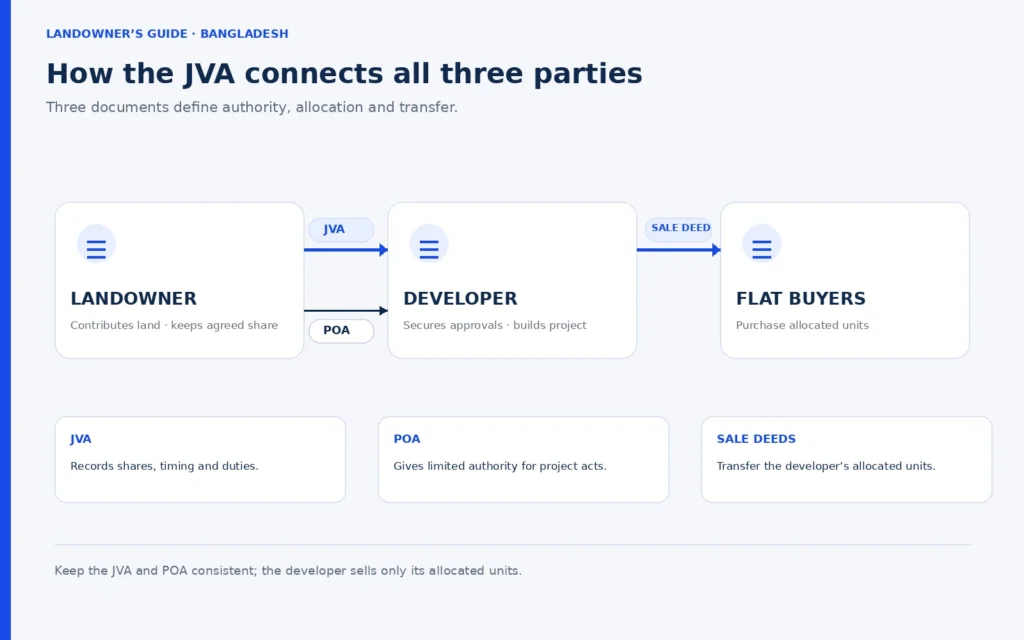
The agreement is only the entry point. Completing a project and handing it over properly to the landowner and to the developer’s customers requires the following documents:
- The joint venture agreement, which is the basis of the deal and the record of commitments, time, terms and conditions.
- A registered Irrevocable General Power of Attorney (IGPOA) from the landowner to the developer, which lets the developer obtain approvals and sell its own share.
- A Supplementary Deed of Distribution on completion of the project, specifying the actual ratio in square feet along with parking and the undivided and undemarcated share of land.
In the agreements I have drafted and vetted, the construction period is usually set between 32 and 48 months, with a grace period of around 3 to 6 months. What matters just as much is the date from which that period runs: signing, plan approval, handover of vacant land, start of construction or, for leasehold plots, the authority’s (RAJUK, NHA or MoHPW) acceptance of the power of attorney.
The important point is that the landowner does not sell the land outright. You keep ownership of your share, but you give the developer legal powers over the rest. That is why the drafting matters more than the ratio. I cover those risks in the sections below.
2. How to secure the landowner’s interest in a JVA
The Real Estate Development and Management Act, 2010 (Act No. 48 of 2010) is the main law on developer projects. The provisions below matter most to a landowner at the signing stage.
| Section | What it says | What you should do |
|---|---|---|
| Section 5 | Developer must be registered with the competent authority; the registration is valid for five years and renewable | Ask for the registration certificate and check its date |
| Section 10 | Written JVA stating the developer’s share, the POA for the developer’s share and the start and completion time; work must follow the agreement | Make sure all three items are written in the agreement |
| Section 11 | Developer must repair construction defects for at least two years from handover, maintain the building for at least one year after handover, and must not reduce facilities or change common space against the approved plan | Copy these protections into the agreement with clear periods and a timeline |
| Section 16 | Developer may mortgage the project only with the landowner’s consent and must clear the mortgage before executing a transfer deed | This is where many developers take undue advantage. Write how consent will be taken and at what stage, and keep your portion out of the loan |
| Sections 25 and 26 | Substandard materials or construction against the approved plan: up to 3 years’ imprisonment, a fine up to Tk 20 lakh, or both | Attach a written specification schedule of fittings, fixtures and amenities. Mention the workmanship standard |
| Section 27 | A developer who signs and then does little or no work, abandons the project without cause and gives the landowner no benefit is treated as committing fraud: up to 2 years, a fine up to Tk 20 lakh, or both | Make a project work plan and record all progress so that non-performance is measurable |
| Section 28 | A landowner who fails to hand over the land within the agreed time: up to 2 years, a fine up to Tk 10 lakh, or both | Do not sign a handover date you cannot meet, for example while tenants remain or an inheritance claim is not settled |
| Section 29 | A landowner who cancels the registered POA without at least 30 days’ notice: up to 2 years, a fine up to Tk 10 lakh, or both | The POA cannot be withdrawn casually once signed. Mention when you can unilaterally apply to the court for cancellation of the POA |
| Section 30 | A developer who does not hand over the landowner’s share or possession on time after completion: up to 2 years, a fine up to Tk 20 lakh, or both | Name your units precisely so this duty can be enforced, and set out the handover procedure with a certificate from the developer |
| Section 36 | Disputes go first to settlement, then to arbitration under the Arbitration Act, 2001; the award binds both sides; if a tribunal is not formed, either party may sue | Draft a workable arbitration clause from the start and always keep all communication in writing |
The Act sets minimum standards. A good agreement goes further. Some other laws also apply: the Contract Act, 1872 for the validity of the agreement, the Registration Act, 1908 for registration, the Power of Attorney Act, 2012 and the Power of Attorney Rules, 2015 for the POA, the Transfer of Property Act, 1882 for later transfers, and the RAJUK building rules and the Detailed Area Plan (DAP) for what can be built on your land.
3. Does the JVA have to be registered?
Section 10 requires a written agreement. It does not directly and expressly require registration. But section 17(1)(b) of the Registration Act, 1908 makes registration compulsory for any non-testamentary instrument that creates or transfers an interest in immovable property.
The power of attorney given to the developer concerns the sale of immovable property, so it must be registered under the Power of Attorney Act, 2012 and the Power of Attorney Rules, 2015. For the general rules, read our guide on power of attorney in Bangladesh.
We advise all our clients, whether landowner or developer, to execute the JVA as a registered deed together with the registered POA. An unregistered agreement is harder to enforce and can leave a dispute hanging for a decade when the relationship breaks down.
How to avoid real estate disputes: 2 steps
Step 1. Verify and clean your own title
Landowners often skip vetting their own title. They think it is unnecessary to spend money on their own land because it has been in the family for decades. In reality, we see that many real estate projects in Bangladesh are paused for title issues that the developer reveals after signing the agreement. Because the title issue is on the landowner’s side, it becomes a legitimate excuse for the developer to hold construction until it is solved. Solving a land case in Bangladesh takes years, so the developer may decide to wait and sell its portion later at a higher price. In Dhaka, this is a common scene in every corner.
When you decide to develop your land, consult a property lawyer for land documents vetting in Bangladesh, ask him to identify any encumbrance that may obstruct construction, and take a written opinion from your lawyer. Also, while signing, put a clause in the agreement such as: “The developer is signing this deed of agreement upon satisfactory legal vetting and acknowledges that no encumbrance was found on the title or possession of the scheduled land. If any complexity arises in future, both parties shall jointly resolve it in the shortest time.”
What should be checked before signing with a developer?
- Chain of title and possession: every deed, via deed and inheritance from the CS record to the latest record, with the share of each owner.
- Record of rights (khatian): CS, SA, RS and BS or City Jarip entries match the deeds, names, successors, plot-wise possession and the land area.
- Mutation (namjari): mutation documents (DCR, proposal and mutation khatian) and land development tax (khajna or dakhila).
- Inheritance: if the land is inherited land, make sure every heir is identified through a warish certificate and every co-sharer is ready to sign. One missing heir in the chain can stop the project or raise a dispute.
- Encumbrance: obtain a non-encumbrance certificate (NEC) confirming that there is no mortgage, bayna, prior agreement or power of attorney.
- Litigation: stop if there is any pending suit, partition case or injunction over the land.
- Government plans: check whether the land is subject to any acquisition (LA) case, is on the enemy property, abandoned property or khas list, or has any government interest.
- Leasehold land: for a RAJUK, NHA or MoHPW plot, the checking needs more precision and care. The rules are separate for residential, commercial and industrial plots. Some plots require prior approval, conversion or amalgamation before a power of attorney. Plan these steps before you agree a construction timeline.
If the property lawyer’s vetting finds any complexity, correct it first. Fixing a mutation or an inheritance gap takes a long time and may delay construction.
Step 2. Know the developer first
It is crucial to know your developer in depth before signing the joint venture development agreement and power of attorney. From the time of signing, the developer will hold your land, all approvals, title documents, possession and exclusive authority under the power of attorney deed. If the land goes to a company that is incapable of turning your dream into reality, it will return unexpected harassment, long waiting, financial pressure and legal disputes in the long run. So what should you check, and how do you understand a real estate developer?
In this part, act like a lender bank and find out what a bank assesses before giving a loan to a developer. Verify the company with the same care.
- Registration and REHAB membership: check the registration certificate and REHAB membership. Please note that a good real estate company may not be a member of REHAB.
- Company records: RJSC incorporation, trade licence, TIN and VAT registration, who the directors are, and their past record, career and expertise.
- Delivery record: visit two or three completed projects. Speak to landowners and flat owners there about handover time, quality and commitments.
- Ongoing projects: how many projects are running at once, investment capacity, market presence and team size.
- Litigation and complaints: cases filed by landowners or buyers, arbitration history and any bank default.
- Financial capacity: the ability to pay the signing money and the monthly rent and to fund construction without selling flats before approval.
- Professional team: an established company has a full-fledged team of architects, lawyers, accountants, sales staff and construction engineers. A company that depends on contractors and external teams is slow and seasonal.
4. Clauses that protect the landowner
Most developers bring their own draft. A developer’s draft naturally protects the developer. Before looking at the safeguard clauses, it is recommended to engage an expert property or real estate lawyer from the very beginning of the negotiation. This is important to fight for the landowner’s interest in the agreement. Besides engaging a property lawyer, review the draft line by line yourself and add or replace what is missing. These are the clauses I check first when I act for landowners in a negotiation.
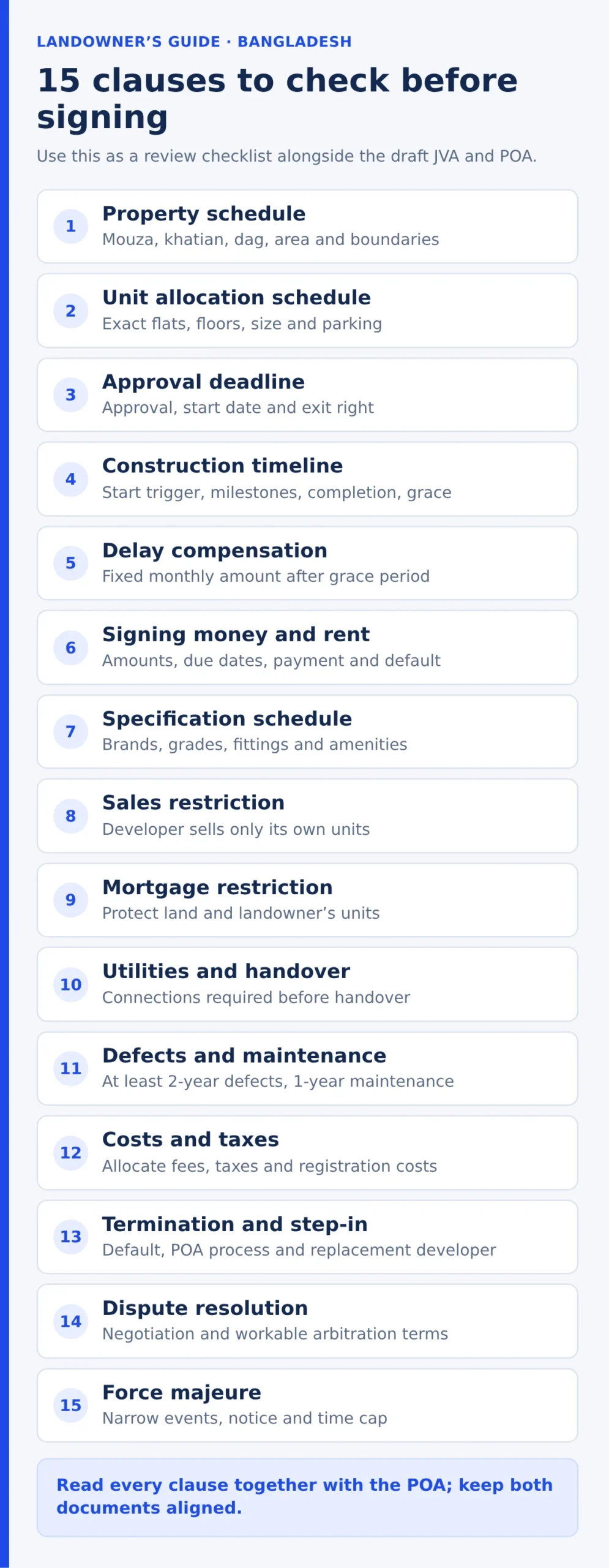
- Property schedule: mouza, khatian and dag numbers, land area and boundary (chowhuddi), matching the title documents.
- Unit allocation schedule: the exact flats, floors, facing, size in square feet and parking spaces for the landowner, attached as a table in the body and schedule part.
- Approval deadline: a date by which the developer must obtain plan approval, the date of construction start and handover, and the landowner’s right to exit if the developer fails.
- Construction timeline: the event from which the period starts, milestones (piling, structure, finishing, utilities), the completion date and a defined grace period.
- Delay compensation: a fixed monthly amount payable to the landowner for every month of delay after the grace period, and when it is paid. Many drafts only say “rent compensation at the prevailing market rate”. That wording leaves the amount open to argument at exactly the time you need it. How the claim is to be submitted and from when the developer shall pay also need to be stated precisely.
- Signing money and monthly rent: amounts, payment dates, modes and the consequence if payment stops.
- Specification schedule: brand and grade of rod, cement, tiles, lift, generator, sanitary and electrical fittings.
- Sales restriction: the developer may sell only its own units, and only after plan approval or a stated construction stage.
- Mortgage restriction: no mortgage of the land or the landowner’s units, a written consent procedure for any project finance, and repayment of the loan before handover of the landowner’s units, consistent with section 16.
- Utilities and handover: who obtains electricity, gas, water and sewerage connections, and handover only with utilities connected.
- Defects and maintenance: a defect liability period of at least two years and maintenance of at least one year after handover, as per section 11.
- Costs and taxes: who bears approval fees, stamp duty, registration costs, taxes and mutation expenses on each side’s share.
- Termination and step-in: the events that allow termination, cancellation of the POA through the agreed process, the landowner’s right to appoint a new developer if the project is abandoned, and the rights of the developer’s purchasers if the developer disappears.
- Dispute resolution: negotiation, then arbitration under section 36, with the seat, the number of arbitrators and the time limits stated.
- Force majeure: a narrow definition with a cap, so that it cannot be used to excuse ordinary delay.
Before signing, read every clause together with the POA. The two documents must say the same thing about what the developer may and may not do. An agreement always prevails over the POA, so settle the agreement first and then the POA.
Sensitive clauses in a developer’s draft
Some clauses are standard in developer drafts and are not unfair in themselves. On a simple reading they look normal, but in practice they open the window to dispute and argument. They need more attention and consideration from both sides of the table.
A. Wide force majeure: in my observation, two types of force majeure affect a real estate site. The first is an act of God and the second is a man-made situation. Wording like “material scarcity”, “government intervention”, “political or financial unrest” or “any other reason beyond the control of the builder” can excuse almost any delay. Limit it to events that genuinely stop work, require written notice to the landowner within a fixed time (for example 15 to 30 days), and state what both parties shall do next.
B. Landowner’s consent to RAJUK and other drawings: keep a specific clause that the developer shall finalise the building design and drawings in consultation with the landowners and with their consent (signature).
C. Developer’s declaration to follow RAJUK rules strictly: keep a clause in the deed of agreement that the developer shall not violate RAJUK rules or the approved plan. If the landowner faces any complexity after handover because of such an act, the developer shall be solely liable.
D. Time exclusion for landowner-side obstruction: if a relative or co-sharer obstructs the work, the lost time is excluded from the completion period. This is reasonable only if your title and family position are clean before signing.
E. Title cleaning at the landowner’s cost: if a title defect appears, the landowner bears the cost of fixing it, but the time is in the developer’s hands. This is another way to extend the handover time legally. So get a legal vetting of your own title first.
F. “Standard specifications of the builder”: specifically mention the fittings, fixtures and amenities to be used, and the alternative or similar brands or products. Without a written specification and an attached specification schedule, the developer decides the product and quality. Whatever he chooses will become its “standard specifications”.
G. Signboard and branding rights: in Bangladesh, developer companies commonly place a permanent company logo on the roof or at the entrance for branding. In most cases the building name is also decided by the developer. Discuss these issues when signing the deed of agreement.
H. Buyers’ bank loans: the developer’s buyers may mortgage their own flats, but the clause should state clearly that the landowner’s units and land share remain free of those loans.
5. The power of attorney: the most risky document
The joint venture deed of agreement records the offer and acceptance of both parties. The power of attorney gives the developer actual power. If the power of attorney is wider than required, it may be abused. The developer can act beyond the agreement, and third parties such as banks and purchasers can rely on it.
A properly limited POA should include the following:
- Cover only plan approval, utility applications and the sale of the developer’s own units, as specifically mentioned in the agreement.
- Mention the landowner’s units in a separate schedule.
- Prohibit mortgage of the land or the landowner’s units without separate written consent.
- Refer to the registered joint venture deed of agreement by deed number and date, and end when the project is completed and handed over.
- Be registered with proper stamp duty and government tax payment.
As per section 29, once a power of attorney is registered under a development agreement, the landowner cannot cancel it unilaterally without at least 30 days’ notice, and an improper cancellation is a criminal offence on the landowner’s part. If the developer is in default, the safer route is a formal notice and the dispute process under section 36, not a sudden cancellation deed. For a RAJUK plot, cancellation also needs RAJUK’s prior approval under its notice effective from 01.03.2023.
6. Share ratio, signing money, monthly rent and delay compensation
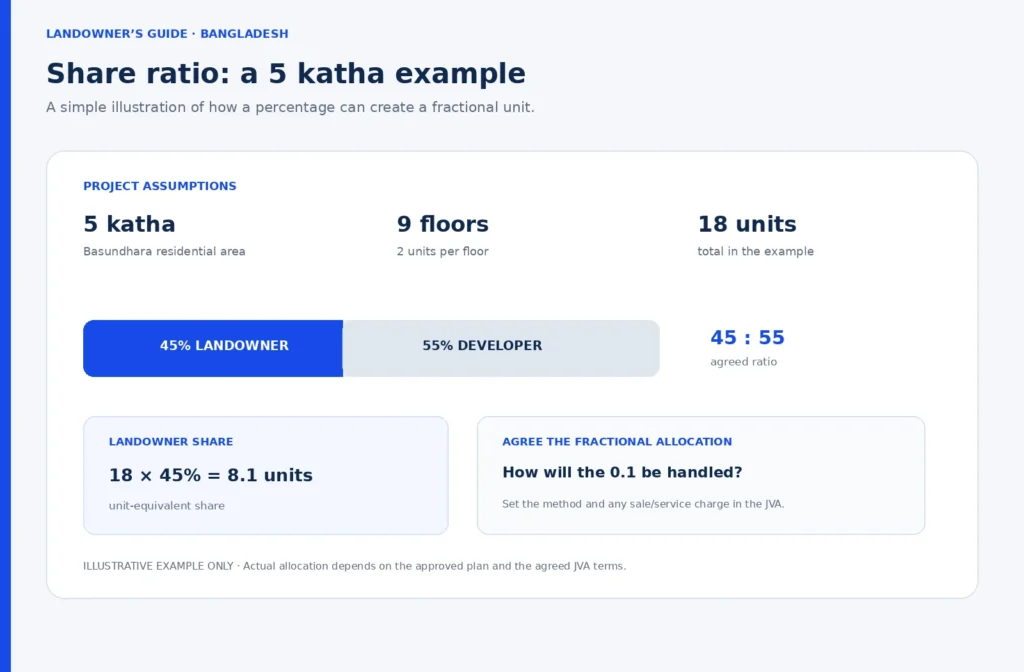
Share ratio: a landowner holds 5 katha in the Bashundhara residential area. The approved plan allows 9 residential floors with 2 units per floor, 18 units in total. At a 45:55 ratio, the landowner receives 8.1 units. That fraction is where disputes begin. How the fraction will be adjusted or sold, and, if the developer sells it, how much it shall deduct as service charge or commission, should be fixed at the signing stage.
Signing money: in a developer agreement, signing money is often stated in a technical way to reduce the tax burden. In most cases it is paid in stages. Link each stage to an event with a tentative timeline (signing, plan approval, piling). As advance income tax (AIT) at 15% applies to signing money, it is usually deducted at source. Agree in writing who bears it, and that the developer gives you a proper AIT receipt on time.
Monthly rent: monthly rent compensates the landowner’s family for the years the land is under construction. Fix the amount, the start date, the payment date and the penalty for late payment.
Delay compensation: if the developer fails to hand over the project in the committed time (construction time plus grace period), the landowner may claim delay compensation in writing. The right to claim delay compensation can be exercised only if the clause exists. Traditional agreements word this as “the developer shall pay delay compensation at the prevailing market rate if it fails to hand over the project on the committed time”. We recommend stating a rent fixed by mutual settlement so that future arguments do not arise.
7. Taxes and other expenses in a joint venture deed of agreement
Taxes apply at three stages in a joint venture agreement:
- When the developer pays you, and when you receive your flats.
- When the developer sells its share.
- When you later sell your own units.
As per section 23 of the Income Tax Act, 2023, the Finance Act, 2026 (amendments) and the Stamp Act, 1899 (amended up to date), the following taxes apply at the rates mentioned.
| Stage | What applies | Who pays | Rate or basis |
|---|---|---|---|
| Signing money, house rent and delay compensation (developer to landowner) | Section 115, Income Tax Act, 2023 | Deducted at source by the developer from each payment to the landowner | 15% of the amount paid |
| Landowner’s allocated flats and other non-cash benefits (new from 1 July 2026) | Capital gains tax, Income Tax Act, 2023 as amended by the Finance Act, 2026 | Landowner | 15% of the net gain. Gain = government (mouza) value of the flats + signing money − original cost of the land |
| Developer’s share sold to its customers | Section 126, Income Tax Act, 2023 | Developer, at the time of registration of the flat | Up to Tk 1,600 per square metre (residential) and up to Tk 6,500 per square metre (non-residential), along with 5% of the land value mentioned in the deed |
| Landowner’s own flat sale | Section 125, Income Tax Act, 2023 and the source tax rules | Landowner, at the time of registration of the flat | Rate varies by area under the rules |
| JVA and POA registration | Stamp Act, 1899 and the registration fee table | Developer | Varies from area to area and land to land. Commonly the highest is around Tk 2.5 lakh |
| RAJUK, NHA or MoHPW POA permission and acceptance | Authority’s fee schedule | Developer | Variable fee set by each authority |
The 2026 change every landowner should know
Until June 2026, only the cash signing money was taxed. From the 2026-27 fiscal year, the flats you receive from the developer are also counted as a gain and taxed at 15%. The tax is not on the full market value of the flats. It is on the gain, calculated with the government mouza value of the flats, after deducting what the land originally cost you.
Illustrative example: a landowner bought 10 katha for Tk 50 lakh twenty years ago. Under the development agreement, he receives Tk 50 lakh signing money and 10 flats valued at Tk 50 lakh each (Tk 5 crore). Total proceeds are Tk 5.5 crore. After deducting the Tk 50 lakh land cost, the gain is Tk 5 crore. Tax at 15% is Tk 75 lakh.
Inherited land, or land bought long ago at a low price, will show a larger gain and a higher tax. Before you agree a ratio, calculate this tax with your tax adviser and decide in the agreement how and when it will be paid.
8. Common mistakes by landowners
- Handing over the original title documents to the developer.
- Acting on oral commitments and avoiding written communication.
- Relying on the developer’s lawyer and signing the developer’s draft.
- Signing a POA wider than the agreement.
- Accepting a percentage ratio without fixing a unit schedule with size, parking and land area.
- Leaving out a delay penalty, exit clause or project timeline.
- Handing over possession before plan approval or before the agreed signing money stage.
- Signing without all heirs and co-sharers, or signing in part.
- Accepting verbal promises about extra floors, parking, the roof and other facilities.
- Ignoring site supervision by your own engineers or architects.
- Keeping no record of communication, or copies of approvals, drawings and sale deeds of the developer’s share. The same flat can be sold twice when nobody keeps track.
- Cancelling the POA in anger without notice, which exposes the landowner under section 29.
- Skipping legal vetting by a property lawyer, or taking it from non-professionals.
- Depending on the media or a broker.
9. What to do if the developer fails after signing
What if the developer fails to keep its promise, abandons the project silently, or stops the construction and the rent after work has started?
The first step is to make a file with the JVA, the POA, the approval file and the sales made so far, and sit with a property lawyer. Make a checklist of events, payments and work done to date.
Then serve a structured notice referring to the agreement and section 36 of the Real Estate Development and Management Act, 2010 (Act No. XLVIII of 2010). If settlement fails, the matter goes to arbitration. In my experience, an arbitration takes 6 to 10 months to settle. Depending on the facts, the landowner may also sue the developer under sections 27 and 30 of the Act, as these are criminal offences.
You may read our article on developer-buyer disputes and JVA issues to understand the whole process.
10. Precautions for NRB landowners
Many landowners from Dhaka live in the USA, the UK, Canada or the Middle East, while the land remains in Bangladesh. As per our chamber data, around 65% of such land is co-owned with other heirs. So it is very difficult for NRBs to follow my suggestions, as their representatives in Bangladesh handle a major part of the negotiation. If that is your position, we recommend keeping these points in mind:
- Sign the JVA in person during a visit.
- If a visit would delay the signing, appoint a lawyer on behalf of all landowners and ask him to finalise the drafts securing your interest and push the developer to agree to them.
- Once the developer agrees, print the draft and have it sent to your residence abroad by DHL or another courier service. Then sign it and have it attested at the Bangladesh mission under the Power of Attorney Rules, 2015, in the name of the developer.
- Do not give a POA to a family member or anyone else, because a POA can’t be given through another POA. Make the POA directly to the developer company.
- Make all communication by email so that the proof is preserved for the future.
- Ask for regular progress updates with photographs and copies of approvals.
- Receive rent and signing money in your own bank account.
See our guide to power of attorney for NRBs for the process from abroad.
11. Documents required for signing a JV agreement and power of attorney
Before signing a joint venture agreement (JVA) or executing a power of attorney (POA), the landowner should get the following documents ready. Exactly which ones you need depends on how you acquired the land and whether it is private land or a government leasehold plot.
(a) Private land (Dhaka and adjacent areas)
Title documents
- Purchase deed (if any)
- Via deed(s) showing the chain of title (if any)
Inheritance documents (where the land came by succession)
- Succession certificate from the court (if any)
- Warishan sanad (inheritance certificate) from the City Corporation, Ward Councillor or Union Parishad
Record of rights and land records
- CS, SA, RS and BS khatian
- Mutation (namjari) documents from the AC Land office, including the mutation khatian, the DCR (Duplicate Carbon Receipt) and the mutation proposal
- Up-to-date land development tax receipt (khajna/dakhila)
Personal documents of the landowner (principal) living abroad
- NID and passport
- TIN and latest tax return (if any)
- Current overseas address
- Passport-size colour photographs
Personal documents of the attorney in Bangladesh
- NID and passport
- TIN and latest tax return (if any)
- Current address in Bangladesh
- Passport-size colour photographs
(b) Leasehold plots in Gulshan, Banani, Baridhara, Uttara and Purbachal New Town
Allotment and lease documents
- Allotment letter
- Possession letter with final measurement
- Instalment payment slips
- Lease deed
- Mutation order (if you are not the original lessee)
Transfer and title chain
- Via deed(s) or power of attorney deed(s)
- Power acceptance letter (if an attorney was previously appointed)
- Deed of distribution with co-sharers (if any)
Mortgage-related documents (if the plot was ever mortgaged)
- Mortgage deed
- Deed of redemption and cancellation of the power of attorney
Encumbrance and possession verification
- Up-to-date NEC (Non-Encumbrance Certificate) from the Sub-Registry office
- Consecutive jote report from the AC Land or Tahsil office
Inheritance documents (where applicable)
- Succession certificate from the court
- Warishan sanad from the City Corporation or Ward Councillor
Record of rights and land records
- CS, SA, RS and Dhaka City Jorip khatian (if recorded)
- AC Land mutation documents with up-to-date khajna, DCR, proposal and mutation khatian
RAJUK approvals (if any)
- Earlier building plan approval from RAJUK
- Construction permission from RAJUK (if taken)
- Occupancy certificate (if any)
Personal documents of the landowners
- NID or passport
- TIN and latest tax return
- Passport-size colour photographs
Company documents (if a company owns the plot)
- Certificate of incorporation
- MOA and AOA
- Form XII (list of directors)
- Company TIN and tax return
Note: this is a working checklist. Not every document is legally required in every case. The final list depends on the source of title, the type of plot and the structure of the deal. Have a property lawyer check all documents together before you sign the JVA or register the POA.
12. Frequently asked questions
Is a joint venture agreement mandatory for developing my land with a developer?
Yes. Section 10 of the Real Estate Development and Management Act, 2010 requires a written agreement between the landowner and the developer.
Can I cancel the power of attorney if the developer is not working?
Yes, but not without notice. Under section 29, cancelling a registered POA given to a developer without at least 30 days’ notice is an offence.
What happens if the developer does not hand over my flats on time?
You may claim delay compensation if the agreement has a clause on it. A developer who fails to hand over the landowner’s share or possession on time after completing the project may face imprisonment of up to 2 years, a fine of up to Tk 20 lakh, or both.
Can the developer mortgage my land to a bank?
Yes, if the agreement and the POA allow the developer to take a loan on its portion.
Is tax payable on my signing money, rent and flats?
Yes. Under section 115 of the Income Tax Act, 2023, the developer deducts 15% tax at source from signing money, subsistence money and house rent paid to the landowner. From the 2026-27 fiscal year, the flats you receive are also taxed as a capital gain at 15% on the net gain, calculated on the government mouza value after deducting the original cost of the land.
Who pays the costs of approval and registration of each side’s share?
The agreement should state clearly who pays plan approval fees, stamp duty, registration costs and taxes on each side’s share.
Need your JVA checked before you sign?
If a developer has offered you a deal, have the draft agreement, the power of attorney and your title documents checked together before signing. Our chamber offers a property verification service for landowners in Dhaka and for NRB landowners abroad. You can contact the chamber to book a document review.
